Billions of Variables: Why Human Minds Can No Longer Handle Modern Math
Applied mathematicians argue that external tools, from ancient boards to modern AI, have shifted complex calculations entirely out of the human brain.
By Andrew Bennett ·
Modern digital infrastructure relies on calculations involving billions of variables or parameters. These figures exceed the processing capacity of the human brain, creating a gap between mathematical creation and human comprehension. Applied mathematicians Steven Strogatz and Alex Townsend address this disconnect in their new book, Big Math: The Hidden Codes That Run Our World.
The text examines how large language models, AI chatbots, and quantum computing have accelerated the scale of 'big math.' Strogatz notes that while pure mathematics literature often ignores computational tools, applied mathematics requires them. He states that the field deals with problems too large to approach mentally. The authors argue that the externalization of math into tools is a historical process rather than a recent development.
Strogatz co-authored a 1998 paper with Duncan Watts on small-world network dynamics. He has also studied chaos theory in physics, the geometry of supercoiled DNA, and biological synchrony, such as flashing fireflies. In 2005, he applied synchrony studies to the wobbling of London’s Millennium Bridge. Strogatz wrote mathematics columns for The New York Times in 2010, 2012, and 2025. He hosted a Quanta magazine podcast from 2020 to 2021 and wrote four popular books, including Infinite Powers, a New York Times bestseller.
Townland is a younger colleague at Cornell University who studies numerical analysis and deep learning. The pair formed a mentorship relationship after Strogatz was assigned to guide Townsend. They began meeting for regular lunches in Risley Hall. Strogatz saw popular potential in Townsend’s course on the top 20 algorithms of the 20th century. Their initial concept focused on big matrix calculations before evolving into the current manuscript.
Strogatz told Ars that the book addresses a gap in the market. “There are so many books about pure math, as if computers didn’t exist,” he said. “Alex and I are both very applied mathematicians. We thought there should be a book on computers and math, especially the class of really big problems with billions of variables or parameters that you just can’t approach in your head.”
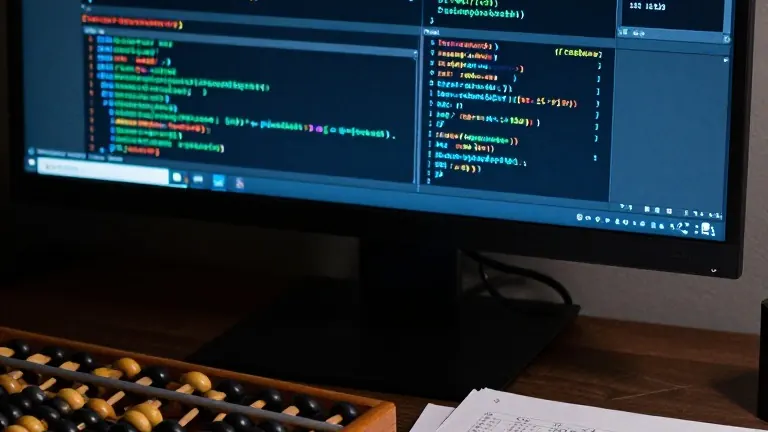
The authors trace the history of external tools back 2,000 years. Strogatz cites the fangcheng, or rectangular array board, as a precursor to modern matrices. This tool allowed users to manipulate systems of linear equations with bamboo sticks. He compares this shift to the abacus changing arithmetic. “A lot of the math we’ve had for centuries perfectly scales up to this computer moment,” Strogatz said. “So this externalizing of math outside of our heads into our tools is a 2,000-year-old idea.”
More Business · Unethical Practices · Report a business · Got a Story?