Braverman Blames London Marches for UK Antisemitism Surge
Former Home Secretary argues that police hesitation to ban pro-Palestinian protests after October 2023 allowed antisemitic incidents to rise to record levels.
By Rosa Wojcik ·
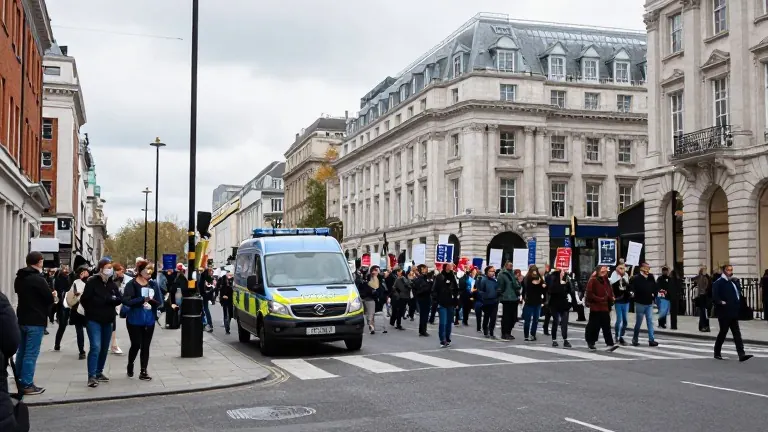
Britain’s rise in recorded antisemitic incidents is directly linked to the government’s failure to ban large pro-Palestinian demonstrations following the Hamas attack in October 2023, according to former Home Secretary Suella Braverman.
Braverman, who joined Nigel Farage’s Reform UK earlier this year, made the assessment in an interview with The Times of Israel. She stated that the weekly marches, which have continued for three years, have not abated because organizers believe they have outlasted the authorities. This persistence has led to antisemitism becoming normalized and almost fashionable, she argued.
The Community Security Trust recorded 1,926 antisemitic incidents in the first half of 2026. This figure represents the second-highest six-month total in the organization’s history. Braverman connected this statistical surge to the Islamist terror attack at Manchester’s Heaton Park synagogue in October 2023, which killed two congregants. She asserted that the failure to act on the marches and the subsequent attack are connected.
In her newly published memoir, Patriot: Empire, Betrayal and Hope, Braverman details her conflict with Metropolitan Police chief Sir Mark Rowley. She accused Rowley of showing implacable resistance to cracking down on the protests. After failing to persuade Rowley to request a ban, Braverman appealed to then-Prime Minister Rishi Sunak. She described Sunak as tired and irritated, eventually calling him a coward for refusing to intervene. Sunak dismissed her in November 2023 after she publicly criticized the police handling of the demonstrations.
Braverman noted that the first major protest occurred on October 8, 2023, before all victims of the Hamas invasion had been identified. The Palestine Solidarity Campaign submitted its application for that day’s march in the early afternoon. She acknowledged that freedom of assembly is a right, but argued it is not absolute and requires peace. She cited chants comparing Israel to Nazi Germany and the scaling of war memorials as evidence that the protests had crossed a line.
Her disputes with the previous government extended to Iran’s Islamic Revolutionary Guard Corps. Braverman said she secured a commitment to proscribe the IRGC when she endorsed Sunak’s leadership bid. However, she claimed the Foreign Office remained opposed to the ban. The Labour government under Keir Starmer did not act until June 2026, when it amended the National Security Act to designate the IRGC under new powers.
Braverman described Starmer, who was ousted by his MPs this summer, as a moderating force against antisemitic elements within Labour. Nevertheless, she criticized his decision to impose a partial arms embargo on Israel in September 2024 and recognize a Palestinian state a year later. She also accused Foreign Secretary Ed Miliband of shaking hands with enemies, referencing his meeting with Iranian Foreign Minister Abbas Araghchi at the United Nations last month.
Braverman pledged that a Reform UK government would take a tougher approach to policing protests. The party plans to ban the Muslim Brotherhood and arrest extremist preachers. She stated that Reform UK is steadfastly a friend of Israel, pointing to the recent launch of the Reform Friends of Israel and the Reform Jewish Alliance.
More Politics · World news · Report a business · Got a Story?